

We have seen high rollers be drawn to Chicken Road not for its playful farmyard theme, but because underneath the clucking hens and dusty crossroads sits a numerical engine designed for explosive, high-volatility sessions. The game does not flirt with moderate, steady returns. It challenges players to push the bet slider to its top limits and weather the stressful dry spells that precede colossal payout clusters. For those of us who consider each spin as a deliberate risk as opposed to a random flutter, Chicken Road requires a strategy that acknowledges its severe variance while leveraging the bonus mechanics that can boost a stake 50 times, a hundredfold, or much more in a single feature activation. We approach this slot not in the manner of a idle entertainment piece but as a strategic challenge where bet sizing, feature buy evaluation, and session timing determine whether we come away with a profit that merits the adrenaline expenditure. In the upcoming sections we dissect every layer that matters to a high roller: the reel architecture, the volatility profile, the bonus rounds that bring the game’s trademark haymaker wins, and the bankroll discipline needed to survive the stretches where the chickens seem determined never to cross the road.
Grasping the High-Volatility Essence of Chicken Road
Chicken Road operates on a volatility model that positions it firmly in the upper tier of risk among modern video slots. When we describe a game as highly volatile, we indicate that the payout distribution is heavily skewed toward infrequent but massive wins, with long sequences of dead spins or tiny returns functioning as the price of admission. In practical terms, a high roller taking a seat with a €50 or €100 base bet can expect to see the balance erode in a jagged downward slope, punctuated suddenly by a bonus trigger that provides a win worth 200, 500, or even several thousand times the stake. The game’s math model does not cater to players who seek hourly entertainment value; it targets those of us who are willing to absorb a negative expectation over dozens or hundreds of spins in exchange for a shot at a life-changing multiplier. We have detected that the hit frequency, the percentage of spins that produce any win at all, hovers in the low-to-mid twenties, which means roughly three out of four spins will return nothing. This is not a design flaw but a deliberate calibration that feeds the bonus reservoir. Understanding this rhythm is the first step toward a viable high-roller strategy, because it determines that we must never chase losses by increasing bet size impulsively. Instead, we set a bet level that allows us to endure at least 200 to 300 spins without exhausting our session bankroll, knowing that the game’s payout peaks gather around the free spin and road-crossing features.
The variance pattern also interacts with the game’s maximum win cap, which we know to be set at a level that makes high-stakes play truly attractive. While the exact cap can differ depending on the casino’s configuration, the slot is designed to allow wins reaching 10,000 times the total bet or more under optimal conditions. For a player wagering €100 per spin, that amounts to a potential seven-figure payout in euro terms, a threshold that places Chicken Road in the same conversation as other high-ceiling slots preferred by VIP players. However, the path to that ceiling is narrow. The bulk of the game’s return-to-player percentage is focused in the bonus features, particularly in the multiplier accumulation mechanics that we will describe later. Base game line hits rarely exceed 15 to 20 times the stake, and even those are rare. We therefore view every base game spin as a toll payment on the road to the feature, not as a standalone profit center. This mindset shift is vital. A high roller who expects regular base game gratification will find Chicken Road irritating and costly. One who budgets for a feature hunt, on the other hand, can synchronize their session structure with the game’s actual payout architecture.
Triggering Free Spins and the Street Crossing Bonus Round
The operational mechanics of triggering the bonus features in Chicken Road merit dedicated attention because high rollers can apply specific tactics to enhance their feature hit rate. Free spins are activated by scatter symbols that land on reels two, three, and four, and these symbols are not reliant on paylines. This means that every spin carries the same independent probability of getting the needed scatters, and there is no pattern that a player can use. However, we have seen that the game’s volatility clustering commonly results in periods where scatters show up with greater density, and we employ a dynamic bet sizing approach to take advantage of these clusters. When we notice two scatters hit on multiple spins within a short sequence, we increase our bet incrementally, reasoning that the arbitrary distribution is currently favoring scatter appearances. This is not assured, but it coordinates our larger bets with the times when a trigger is statistically more likely based on recent observed frequency. We also watch the road crossing bonus trigger, which can appear as a random overlay on any spin. Some versions of the game allow players to boost the chance of this random trigger by activating an ante bet feature, which applies a small percentage to the bet in exchange for a higher probability of the bonus game activating. For high rollers, the ante bet is typically worth the additional expense because it directly increases the occurrence of the feature that offers the most consistent returns.
When the feature purchase is offered, we assess it using a strict cost-benefit lens. Acquiring the feature spins at 100x the bet means we are spending extra to bypass the base game grind. The expected value of a purchased bonus round, after factoring in the RTP contribution, is generally somewhat below the purchase price over the long run, but the time saved and the volatility reduction can justify the expense for a high roller with a large bankroll. We commonly utilize bonus buys as a session starter, buying three to five features in quick succession to test the game’s payout mood. If the first few buys produce above 80% of the purchase cost, we continue. If they produce a string of low-paying rounds below 30x the bet, we interpret this as a negative variance signal and either change to organic spin triggering or conclude the session. This hybrid approach merges the immediacy of feature buys with the patience of scatter hunting, and it has proven effective in managing the game’s unpredictable payout distribution.
The Wagering Spectrum and How Whale Players Can Maximize Stake Efficiency
Chicken Road provides a bet range intended to serve both casual players and dedicated high rollers, typically starting at a minimum of €0.20 and going upward to a maximum of €100 or even €200 per spin, depending on the operator’s settings. For our purposes, the lower half of that spectrum is unimportant. We concentrate on the upper band, where each click of the spin button signifies a substantial financial commitment. The key to stake efficiency lies not in blindly maxing out the bet but in aligning the wager to the feature buy cost, if the game provides a bonus buy option, and to the projected bonus frequency. When we determine the cost per bonus trigger, we can assess whether buying the feature outright offers a mathematical edge in terms of time and volatility reduction. In many jurisdictions, such as those covering German players, the bonus buy feature is present and priced at a multiple of the base bet, frequently around 80x to 100x the current stake. A high roller staking €50 per spin would consequently pay €4,000 to €5,000 to jump directly into the free spins. We balance this against the estimated average payout of the bonus round, which, considering the game’s high volatility, can vary wildly but tends to group around 60x to 120x the bet in normal play, with outlier results reaching far higher.
Our strategy to bet sizing incorporates a multi-tier strategy. We frequently start a session at a moderate level within the high-roller range, around €20 or €30 per spin, to assess the game’s rhythm and to observe how frequently the scatter symbols land. If we spot a pattern of near-miss bonus triggers, where two scatters appear again and again, we may interpret this as a sign that the game is in a feature-dispensing phase and bump our bet to €50 or €75. This is not superstition but a pragmatic response to the apparent clustering of scatter symbols that many volatile slots exhibit due to their random number generator seeding. Furthermore, we always check the game’s information panel for any bet-dependent changes to the RTP. Some versions of Chicken Road adjust the return percentage marginally at higher bet levels, giving a somewhat better theoretical return to high rollers. Even a 0.2% RTP improvement can add up significantly over thousands of spins at €100 per pull. We check this detail on the official paytable before dedicating to a session, and we choose casinos that present the RTP clearly for each bet tier.
The Core Mechanics: Spinning Reels, Win Lines, and Winning Ways
Chicken Road is constructed on a grid that extends the conventional slot layout into a a more flexible playing field. The game typically presents a five-reel structure, but the row height is not static. Depending on the phase of play, the grid can increase from a basic three-row setup to a higher configuration with four or even five rows, which immediately increases the number of active ways to win. In the base game we usually start with 243 ways, a format that pays for matching symbols on adjacent reels from left to right irrespective of their vertical position. When the grid enlarges during certain features, the ways-to-win count can climb to 1,024 or beyond, amplifying the combinatorial possibilities and setting the stage for multi-way hits that stack symbol wins across dozens of lines simultaneously. For a high roller, this expanding grid mechanic is not just a visual gimmick; it is the engine that changes a modest line hit into a screen-filling payout when premium symbols land in clusters. We pay close attention to the row expansion triggers because they suggest that the game is moving into a higher payout gear, and we often adjust our bet sizing expectations accordingly.
The symbol hierarchy adheres to a well-known farmyard narrative but with payout values that benefit patient high-stakes play. The lower-paying symbols are typically the card royals, designed as wooden signs or painted eggs, while the premium icons feature a fox, a farmer, a tractor, and the chicken herself. The chicken symbol serves as the highest-paying standard icon, and landing five of them across a full pay way in the base game can deliver a payout of 10 to 20 times the stake, a strong but not spectacular return that merely keeps the bankroll ticking over. The real value appears when wild symbols and multipliers come into the equation. The wild, often depicted by a golden egg or a road sign marked “WILD,” replaces for all regular symbols and can appear stacked on the reels. In the expanded grid state, stacked wilds covering entire reels can combine multiple premium symbols across hundreds of ways, producing base game wins that occasionally match modest bonus round results. We always monitor the wild distribution because a reel set heavy with wilds in the base game often precedes a feature trigger, and we may opt to increase our bet slightly if we detect the game is moving toward a bonus.
RTP and Its Impact on Sustained High Roller Strategy
The expected payout rate of Chicken Road is something we examine before every session because even fractional differences compound into substantial sums at high stakes. The standard RTP is typically configured around 96.5%, which puts it above the industry average and renders it an appealing choice for serious players. However, we need to know that operators in Germany and across Europe might present the game at lower RTP settings, dipping to 94% or even 92% in unfavorable configurations. We always examine the paytable or the game rules screen, where the RTP is required to be displayed, and we avoid any version that falls below 96%. The disparity between a 94% and a 96.5% RTP on a €100 bet over 1,000 spins equates to an expected loss difference of €2,500, a figure that no high roller should overlook casually. Additionally, the RTP figure incorporates the contribution of the bonus features, implying that a significant portion of the return is locked behind the free spins and road crossing game. This strengthens our strategy of prioritizing feature access, whether through organic triggering or bonus buys, because the base game alone cannot support a positive long-term expectation.
We also take into account the concept of RTP realization over finite sessions. A 96.5% theoretical return is a long-run statistical average that could never manifest in a single evening of play. High rollers who cycle through thousands of spins per month will experience the RTP smoothing out, but those who play in short, intense bursts must accept that actual returns can differ wildly. Our approach is to treat each session as a standalone event with a predefined loss limit and a target win goal, rather than depending on the RTP to guarantee a recovery. We set a session loss cap of 200 to 300 times our base bet, which for a €50 bet means a maximum loss of €10,000 to €15,000. If we hit that limit without triggering a significant bonus round, we end the session and return another day. Pursuing the RTP by extending play beyond the loss cap is the fastest way to diminish a high-roller bankroll, because the game’s volatility can produce extended negative variance streaks that greatly surpass the theoretical expectation in the short term.
Bonusové funkce Zvyšující High-Stakes Returns
Bezplatné otočky a násobičová stopa

The free spins feature tvoří základ test Chicken Road Road’s payout potential and the primary reason, proč se na ni zaměřují vysocí sázkaři tuto automatu. Triggering the feature potřebuje dopad tří a více scatterů na libovolném místě válců, kde scatter představuje a road sign or a chicken crossing warning. Three scatters award základních 10 volných zatočení, four scatters increase startovní počet na 15, a pět scatterů odemyká 20 free spins along with an instant coin prize that can reach 50x the bet. V průběhu bezplatných otoček, se zapíná multiplikační stopa, displayed prominently above the reels. Každý divoký symbol, který se objeví posouvá dráhu o jeden krok, čímž zvyšuje globální násobič výher that applies to all subsequent free spin wins. The trail can climb od výchozího 1x násobiče k 2x, 3x, 5x, and eventually to a cap that often sits at 10x or 15x, i když existují verze, kde je strop ještě vyšší under special conditions. Pro hráče s vysokými sázkami, který sází 100 € za zatočení, a 10x multiplier applied to a screen full of premium symbols může přinést výhru za jednu otočku nad 50 000 €, a opětovná aktivace může toto dramaticky znásobit.
Přilepivé divoké symboly a mechanika kuřecího útěku
During the free spins, certain wild symbols function in a different way according to the game phase. When the chicken escape mechanic kicks in, any chicken symbol that appears on the reels converts into a sticky wild that stays locked in place for the duration of the free spins. This mechanic is frequently tied to a special animation where a chicken endeavors to cross the road, and if it manages, the sticky wild is granted. We have seen rounds where three or four sticky wilds gather on the middle reels, creating a guaranteed win on every subsequent spin as long as any matching symbols land on the remaining reels. The combination of a high multiplier from the trail and multiple sticky wilds can generate sequences where every free spin delivers hundreds of times the bet. As high rollers, we eagerly root for early sticky wild accumulation because it transforms the feature from a hopeful gamble into a near-certain profit generator. We also note that the feature can be reactivated by landing additional scatters during the free spins, granting extra spins to the tally and keeping the accumulated multiplier and sticky wilds, which is the scenario that produces the game’s maximum win ceiling.
The Road Dash Bonus Feature
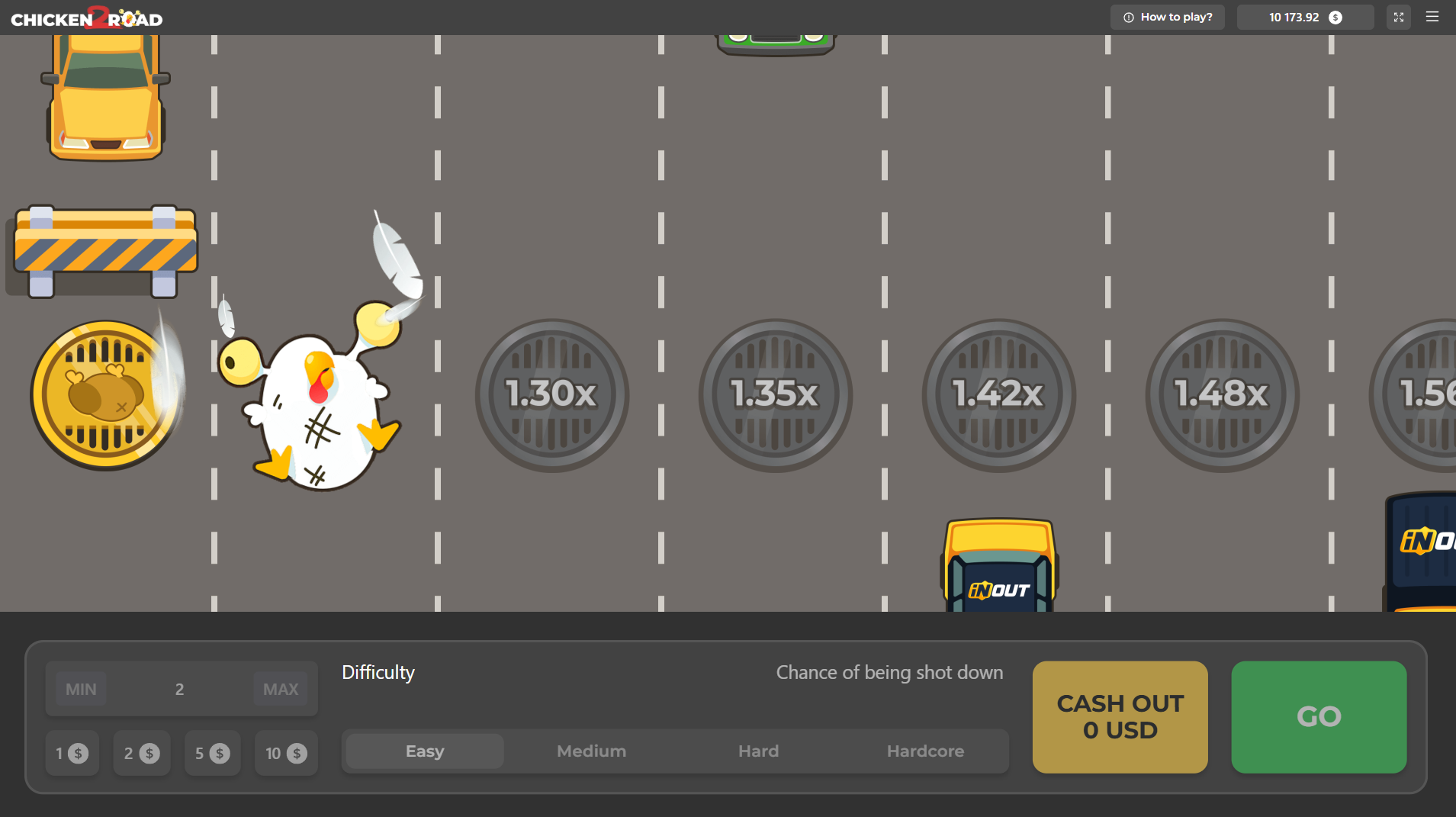
Apart from the free spins, Chicken Road includes a additional bonus feature that high rollers should not overlook: the road crossing bonus game. This feature can activate randomly on any base game spin or may be granted when a special bonus symbol shows up on the first and fifth reels simultaneously. Once activated, the player is brought to a separate screen where a chicken stands at the edge of a multi-lane road. The road is separated into several rows, each showing a multiplier value that rises as the chicken progresses. The chicken tries to cross the road one lane at a time, and at each step a random event dictates whether it advances, is hit by a vehicle and loses a life, or gathers a cash prize. The feature persists until the chicken either crosses all lanes and wins the grand multiplier, often valued at 500x to 1,000x the bet, or runs out of lives. For a high roller, this bonus game presents a different volatility profile than the free spins. It has a tendency to produce more consistent mid-range wins, with the average payout clustering around 40x to 80x the bet, but the top prize can compete with a strong free spin round. We value this feature as a bankroll stabilizer that can restore funds during a long free spin drought.
Bankroll Management and Playing Approaches for High Stakes
Effective bankroll management for Chicken Road at high limits requires a structure that factors in the game’s specific volatility metrics and bonus frequencies. We commence by establishing the total session bankroll, which should be an amount we are fully prepared to lose without emotional distress. For a high roller, this might range from €10,000 to €50,000 or more. We then divide this bankroll into units, where one unit equals our base bet. A common structure we employ is to allocate 300 to 500 units per session, meaning a €50 base bet requires a session bankroll of €15,000 to €25,000. This allocation is not arbitrary; it is calculated from the projected number of spins required to hit a bonus feature and the potential drawdown during a dry spell. We have recorded our own play data and found that a bonus trigger commonly occurs once every 120 to 180 spins on average, though stretches of 300 or more spins without a feature are not uncommon. A 500-unit bankroll supplies a buffer that can handle a prolonged feature drought without forcing us to stop prematurely.
We also implement a graduated stop-loss and take-profit system. The stop-loss is set at 50% of the session bankroll, meaning if we start with €20,000, we walk away when the balance drops to €10,000. This hard limit stops the emotional spiral that leads to chasing losses with oversized bets. On the profit side, we set a take-profit target of 100% to 150% of the session bankroll. If we double our money, we secure the win and end the session, no matter how hot the game feels. The temptation to let a big win ride is powerful, but Chicken Road’s volatility can wipe out a €15,000 profit in a handful of dead spins. We have realized to treat a doubled bankroll as a completed mission accomplished. Additionally, we space out our bet increases. Rather than jumping from €50 to €100 in one move, we step up in increments of €10 or €20 after a win that exceeds 50x the bet, and we step back down after a series of 20 consecutive losing spins. This gradual approach smooths the variance and keeps us in the game longer, which is the ultimate goal of any high-roller strategy on a slot as demanding and profitable as Chicken Road.